

Do Any Us Military Forces Use Weapon Shield Cleaning And Lubrication Oils For Their Weapons
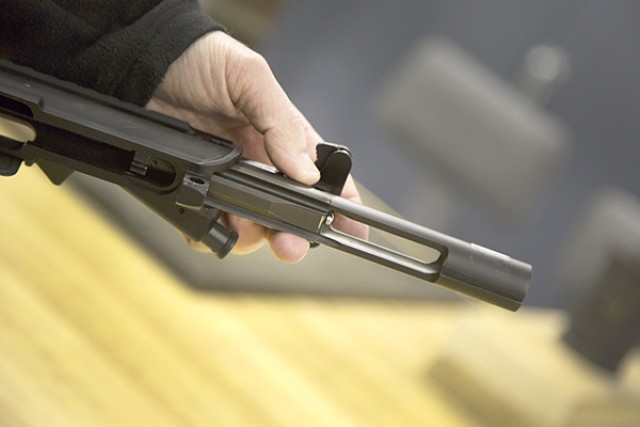
PICATINNY ARSENAL, North.J. -- Although weapon maintenance may seem tedious to the unencumbered civilian, Picatinny Arsenal engineers know a clean weapon could save the warfighter's life.
That'southward why they are developing an avant-garde surface treatment for armament components that not just mitigates weapon maintenance but also provides increased reliability and immovability.
Currently, when cleaning a weapon, warfighters use a conventional wet lubricant known as CLP (cleaner, lubricant, and preservative) that is continuously reapplied.
CLEANING METHODS ARE Disquisitional
As early on as 2003, the Ground forces was experiencing problems with weapon stoppages in sand and dust environments if proper lubrication procedures and cleaning methods were non followed.
Army engineers recognized the importance of weapon maintenance in these extreme environments.
Thus, they set out to identify a materiel solution, which resulted in a Durable Solid Lubricant.
"The new technology eliminates CLP and uses a dry surface treatment known as durable solid lubricant, or DSL, that is applied during ammunition component manufacturing," said Adam Foltz, an experimental engineer at the U.Southward. Armament Research, Development and Engineering Center, or ARDEC.
"So far the DSL has been practical to small and medium quotient weapons, such as rifles, like the M4A1 Carbine, and machine guns like the M240 to demonstrate the technology capability," Foltz connected.
Every bit a consequence of using the durable solid lubricant, weapons office properly, require less maintenance, and the war-fighter has more peace of listen regarding possible weapon malfunctions.
Foltz is part of a team of ARDEC engineers who prepare out to perform a rigorous plan of material screening experiments for an improved lubricant. The team was established with a cantankerous-functional squad of subject area matter experts.
Bated from Foltz, who is with the Individual Weapons Branch, other team members are Christopher Mulligan, research engineer (specializing in surface technologies) from Benét Laboratories, and Doug Witkowski, a project officer at the Weapon Software and Applied science Center.
The team was challenged past its sponsor, the Articulation Service Small Artillery Program, to mature and transition the DSL applied science to Projection Manager Soldier Weapons by FY17.
"The Soldier knew that something had to be done," said Witkowski.
"These extreme environments necessitated rigid adherence to weapon maintenance schedules and had a trend to degrade weapon performance if scheduled maintenance lapsed.
"The Soldier knew that if this trouble connected that operational availability would exist compromised and that the warfighter's mission readiness would exist impacted."
Witkowski added that the warfighter was experiencing like problems with machine guns. "Army engineers understood the importance of maximizing weapon reliability and reducing the sensitivity of system operation in agin environments," Witkowski said.
The program, a science and applied science funded project, began as a response to the U.S. armed forces's Global War on Terrorism entrada to counter terrorist attacks on the U.s.a..
Withal, Picatinny was not the start group to experiment with developing new surface treatments. A number of commercial and congressional programs as well attempted to improve surface treatments for armaments over the past 15 years just were unsuccessful in finding a materiel solution.
The challenge of a development effort like this is finding a solution that can practice all the things that CLP does, and do them improve, said Foltz.
MULTIPLE BENEFITS
The DSL solution achieves iii ideal outputs: a lower friction coefficient, better wear resistance, and improved corrosion protection. "Friction coefficient" describes how a weapon slides; a low coefficient ways the weapon slides hands, a high coefficient suggests sliding resistance.
"With typical moisture lubricants, Soldiers need to reapply in order for the weapon organization to role properly. Soldiers also have to regularly clean off carbon balance that builds up from firing and information technology can be tough to make clean," explained Foltz.
"Our DSL has a high wear resistance and a low friction coefficient, so it'due south easy to clean off anything that builds upward. You can use a steel castor to knock off whatsoever residue, and you don't even have to worry about reapplying anything."
Additionally, the current industry standards for preventing corrosion on armament components involves treating steel parts with phosphate and oil while aluminum parts are anodized (coated with an oxide layer.)
DSL uses a benign material that eliminates the need for a phosphate/oil coating process, making information technology an environmentally friendly solution.
DEVELOPMENT STRATEGY
To accomplish these goals, the team broke the project into iii testing stages, progressing from lab scale experiments to live burn testing in club to rapidly and effectively evaluate solutions.
The first phase involved tribiological testing of 27 different coating combinations in a rapid "brawl-on-three-deejay" test. During this test, a brawl--coated with the unlike candidate coatings-- is brought into rotating, sliding contact at a specified load against three pads, which are also coated with the diverse candidate coatings.
Then, the friction coefficient is recorded and habiliment on the pads is measured. The samples were tested in various environments including with and without sand, as well as at ambient and elevated temperatures (upwardly to 480 �F) to evaluate overall stability.
In stage two, the 27 combinations were downward-selected to six cloth combinations and placed in the squad's slide-rail simulator.
The team created the slide-rails simulator to glean a more authentic representation of the unique geometry, movement, and contact stresses typical in the gun.
The simulator included two pieces of metal (denoted a slide and a rail) coated with the materials of involvement that slide against each other in a style meant to simulate specific weapon deportment.
In stage three, the team down-selected to four unlike promising material combinations and did a small-scale-scale alive fire test at the Armament Technology Facility. Testing included ambient endurance firing, hot and cold, sand/dust, and common salt/fog.
In the ambient environment, the project team shot 15,000 rounds per weapon. The baseline weapons with the CLP showed wear and complete loss of the phosphate on approximately 75 percentage of the bolt carrier sliding surfaces and 90 percent of the bolt.
Meanwhile, the DSL cloth showed less than v percent wear on both the bolt carrier and bolt.
In every case, the DSL cloth showed either an improved or an equivalent performance to the CLP baseline. Results demonstrated increased wear resistance, increased reliability, and improved maintainability.
Although this project is ongoing, the payoff for the warfighter continues to ascension. According the team, the DSL material has potential application to numerous other ammunition systems, manufacturing machinery, and advanced oil-gratis turbomachinery.
For now, though, the side by side stage for the DSL project is a repeat of stage three, but on a larger scale.
If testing is successful, the project volition be transitioned to Project Managing director Soldier Weapons, which volition somewhen field it to its ultimate client, the warfighter.
"I know that it [weapon maintenance] is not a glamorous topic and when you lot're briefing, there are higher profile technologies being briefed," said Witkowski. "But this is a high-tech innovation and they [the warfighters] will love it, when they get it."
-----
The U.S. Army Armament Research, Evolution and Engineering Center is office of the U.S. Army Research, Development and Applied science Command, which has the mission to ensure decisive overmatch for unified country operations to empower the Army, the joint warfighter and our nation. RDECOM is a major subordinate command of the U.S. Army Materiel Command.
Related Links:
Army Technology Live
U.Southward. Army Armament Research, Development and Technology Center
U.S. Army Materiel Command
Army.mil: Science and Technology News
U.S. Army Research, Development and Applied science Control
Picatinny Facebook
ARDEC Facebook

Source: https://www.army.mil/article/161883/warfighter_weapon_maintenance_made_easier_with_new_lubricant
Posted by: gonzalezpurping.blogspot.com
0 Response to "Do Any Us Military Forces Use Weapon Shield Cleaning And Lubrication Oils For Their Weapons"
Post a Comment